Calculate material costs in a hair salon: a simple formula for colorists
Learn how colorists and small salons calculate material costs per color service, understand margin, and spot recurring overmixing more clearly.
Colorists, independent stylists, and small salon teams
12/05/2026, 09:00
Many color services look profitable at first. The price is set, the client is happy, and the appointment is finished. Still, the real margin can be lower than expected.
One common reason is simple: material costs are estimated instead of documented.
Color, developer, gloss, treatments, foils, gloves, and backbar products can look small one by one. Across many appointments, a few extra grams can become a recurring cost.
What counts as material cost?
Material costs are the direct products and consumables used for a specific service. For colorists, this usually includes color, toner, lightener, developer, bonding or care products, foils, gloves, and any treatment that belongs directly to the service.
The goal is not to make the first version perfect. A salon can start by documenting the products that affect the price most often, then add more detail as the workflow becomes routine.
- Color, demi, toner, gloss, or lightener.
- Developer or oxidant used in the service.
- Bonding, chelating, detox, or treatment add-ons.
- Foils, gloves, and other direct consumables.
- Backbar products when they are part of the service cost.
The simple formula
The basic calculation is: material cost = amount used × cost per unit.
Example: 40 g of color × €0.18 per g = €7.20.
For the whole appointment, add every direct material cost together: total material cost = color + developer + add-ons + consumables.
Then calculate gross profit: gross profit = service price − material cost.
Gross margin percentage is: gross margin = gross profit ÷ service price × 100.
This does not replace full salon pricing with rent, payroll, taxes, and fixed costs. It shows how much of the service price remains after the direct materials used in the appointment.
Example: calculate one color service
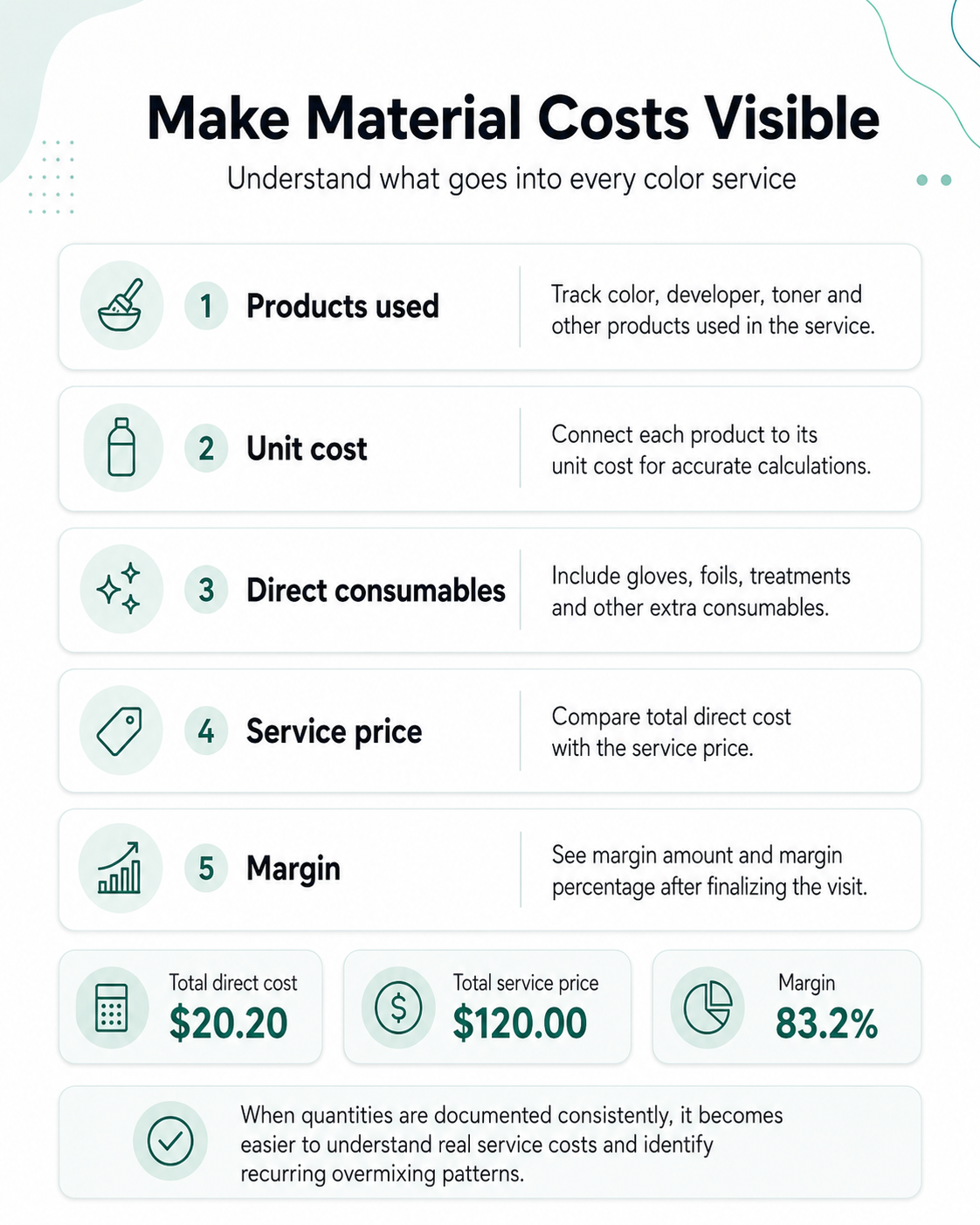
Assume a salon charges €120 for a color service. The direct materials are 45 g color at €0.18 per g, 70 g developer at €0.03 per g, 25 g gloss at €0.20 per g, one treatment at €3.50, and €1.50 in consumables.
The total direct material cost is €20.20. With a €120 service price, gross profit is €99.80 and gross margin is 83.2%.
The number itself is useful, but consistency matters more. If material costs are only guessed, the salon cannot see which services are repeatedly drifting away from the intended margin.
Why estimates cause problems
Experienced colorists often know roughly how much product they need. That judgment is valuable, but it can still hide cost patterns.
The problem is rarely one appointment. It is repetition. If 30 color services per month miss only €2 of material cost each, that is already €60 per month. With balayage, correction, long hair, or high product use, the gap can be much larger.
- A little more product is mixed than needed.
- Leftover product is not noted.
- Add-ons are forgotten in the calculation.
- Consumables are treated as too small to track.
- Product prices change, but the service calculation stays old.
- The next formula is rebuilt from memory.
Why leftover amounts matter
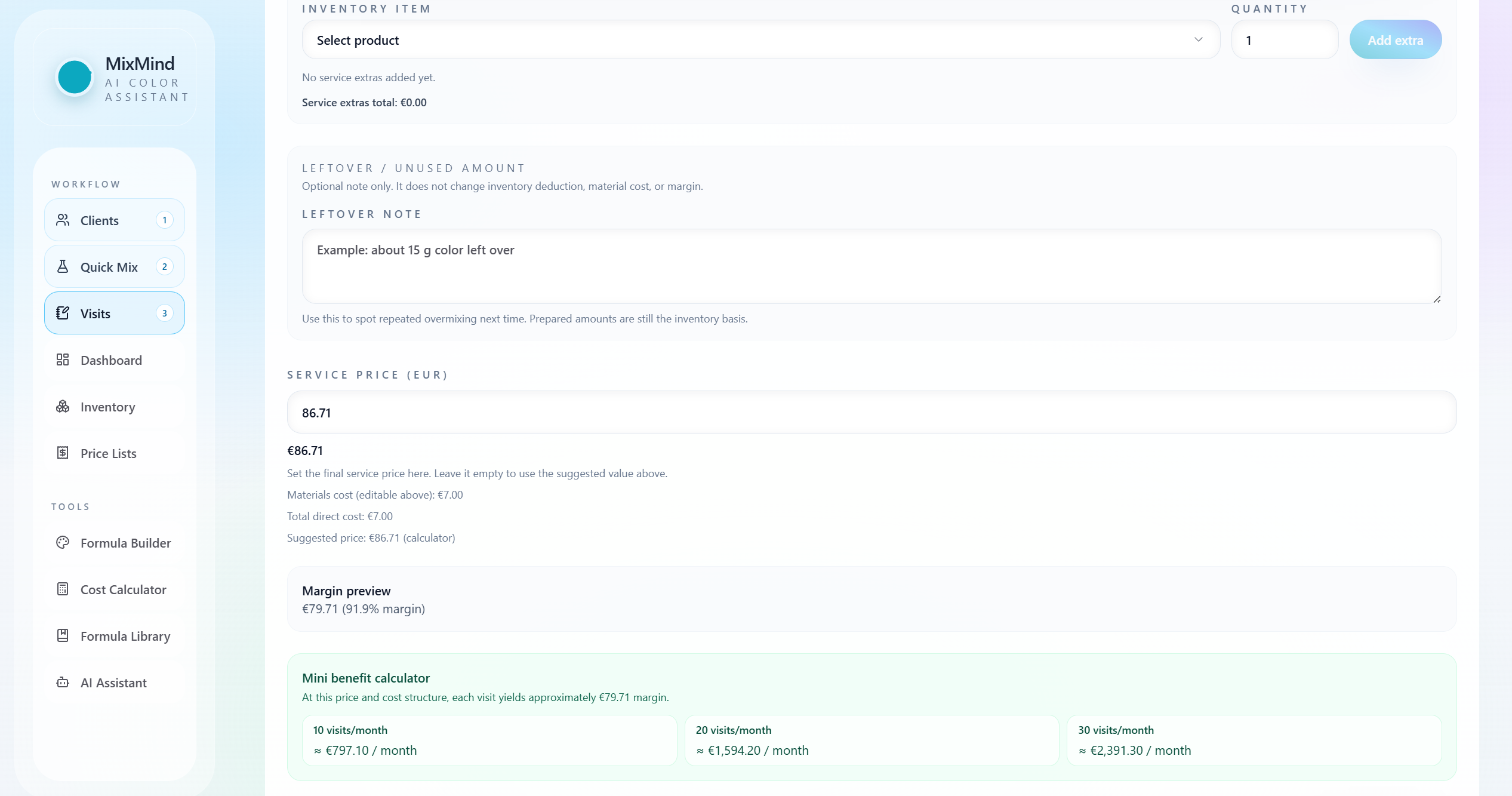
Overmixing means more product is prepared than the service actually needs. One small leftover amount can look harmless. If similar services regularly leave product in the bowl, it becomes a recurring cost signal.
At the beginning, this does not need a full waste analytics dashboard. A simple optional note is enough to make the pattern visible next time.
Example: prepared 90 g, about 15 g left over, note for the next similar service: mix a little less.
MixMind treats this as a note. It does not automatically change inventory deduction, material cost, or margin. Prepared amounts remain the basis for cost and inventory decisions.
What colorists should document
A practical material cost record can stay short. The most useful fields are the client, visit date, service type, products used, prepared amount in grams or milliliters, service price, direct material cost, and formula result notes.
If the salon wants to track overmixing more clearly, it can also add an optional leftover note such as “about 15 g color left over”.
- Client and visit date.
- Service type and formula notes.
- Products and prepared quantities.
- Optional leftover or unused amount note.
- Service price, material cost, and margin.
- Result notes for the next appointment.
Common calculation mistakes
The most common mistake is mixing purchase price and usage unit. A tube may cost €12 and contain 60 g, but the service only uses part of it. The useful unit is €12 ÷ 60 g = €0.20 per g.
Developer is another frequent blind spot. It is often cheaper than color, but it is used regularly and sometimes in larger amounts.
Treatments and add-ons should also be visible. If they are included in the service, they belong in the material cost. If they are charged separately, they should be clear as add-ons.
How MixMind helps
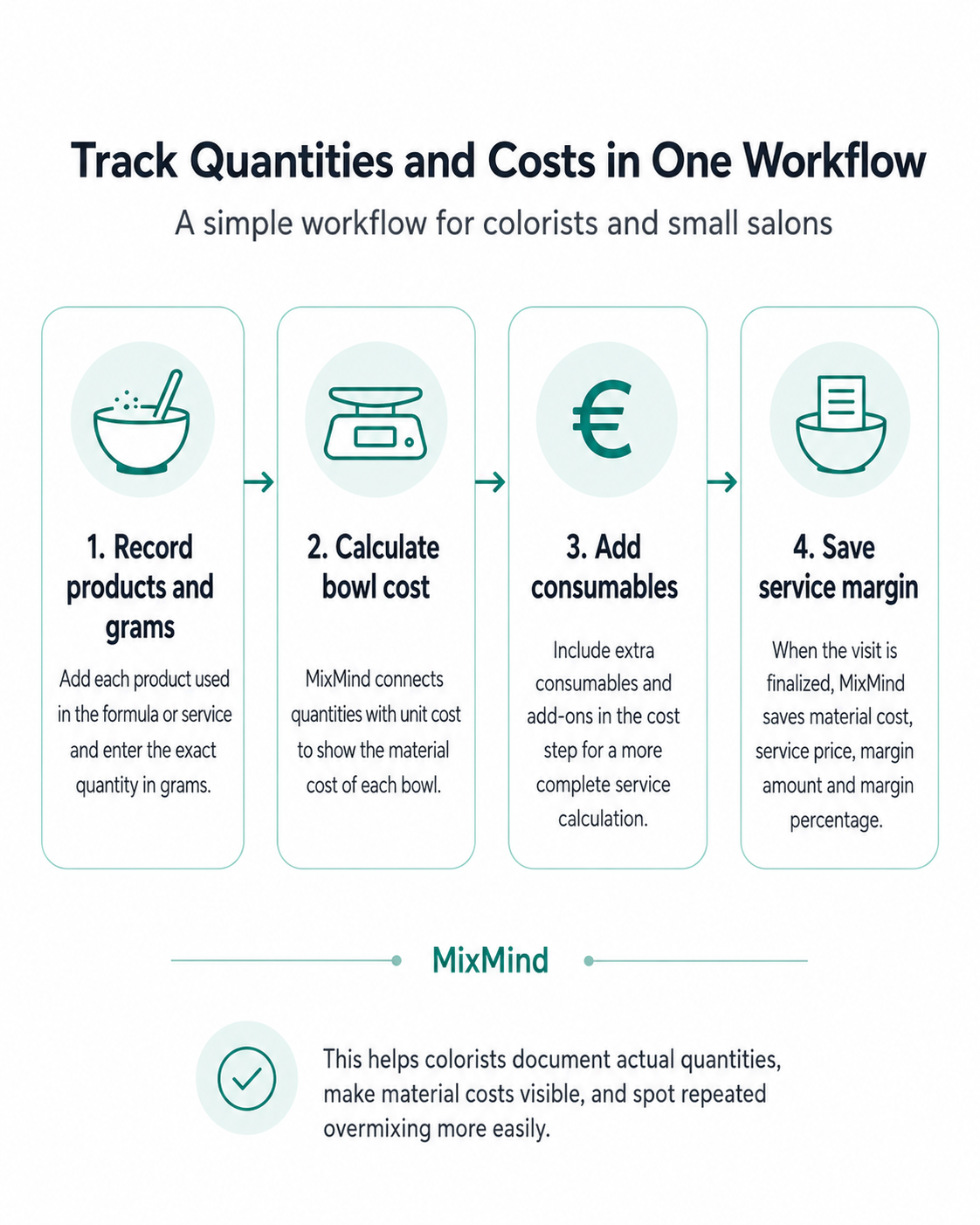
MixMind is built for colorists and small salons that want formulas, visits, product use, and material cost in one workflow.
Instead of spreading formulas, notes, costs, and margin across paper, spreadsheets, and memory, MixMind keeps them attached to the appointment.
- Save and reuse color formulas.
- Document client visits and service details.
- Record products and prepared quantities.
- Calculate material cost per service.
- Add direct consumables and add-ons.
- See margin directly in the visit.
- Optionally save leftover amounts as a note.
- Make product use easier to review later.
What becomes visible
A color service is more than the final price. The useful questions are: which formula was used, which products were mixed, how many grams were planned, which add-ons were included, what were the direct material costs, what margin remained, and was there a leftover amount to consider next time?
When this information lives in one place, the next consultation is easier. The colorist can see what worked, what cost the service actually carried, and where the calculation can improve.
Conclusion
Material costs do not need to be complicated. A simple calculation per service helps salons understand prices, spot hidden losses, and calculate color services more clearly.
Anyone who works with color regularly should know not only which formula works, but what that formula actually costs.
FAQ
Does MixMind automatically calculate waste analytics?
No. MixMind can save an optional leftover note for a visit, but it does not automatically calculate waste reports or change inventory based on leftover amounts.
Should leftover product reduce inventory differently?
Usually no. Prepared product has already left usable inventory, so prepared amounts remain the practical basis. The leftover note helps the colorist mix more precisely next time.
Is gross margin the same as full salon profit?
No. Gross margin after direct material cost is only one layer. Full salon pricing also needs labor, rent, taxes, card fees, and other fixed costs.